
AI as Infrastructure, Not Innovation
A conversation about why “AI-powered” stopped being impressive

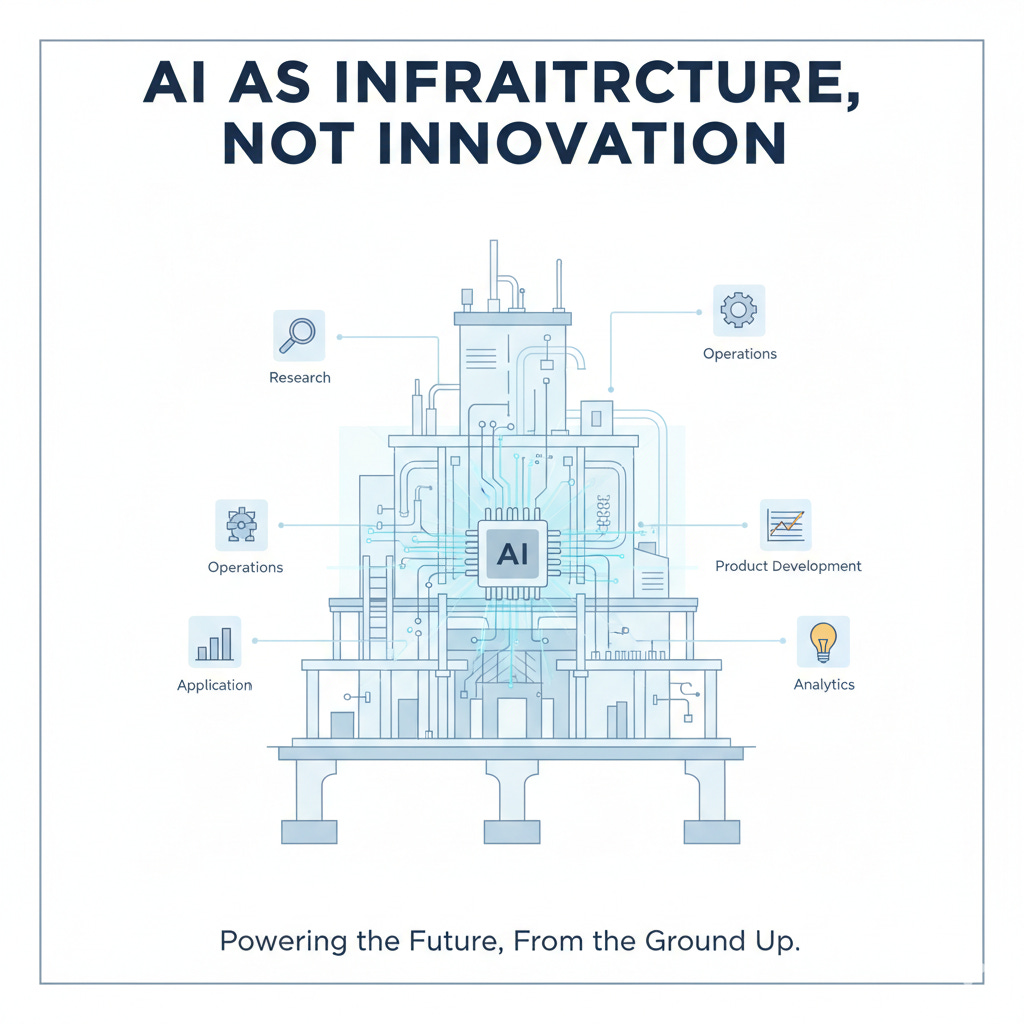
A year ago, adding AI to your product felt like innovation.
Today, it feels like… maintenance.
Not because AI is weaker, but because it’s everywhere.
And that’s usually what happens right before a technology quietly becomes infrastructure.
The Moment You Stop Noticing the Magic
There’s a simple test for whether something is still innovation.
Do users notice it?
Think about:
Search ranking
Spam filtering
Recommendations
Fraud detection
Autocomplete

All of these were once headline-worthy.
Now?
If they fail, users complain.
If they work, nobody says a word.
That’s infrastructure behavior.
We’ve Seen This Cycle Before (Many Times)
Electricity wasn’t a competitive advantage, factories that reorganized around it were.
Cloud computing didn’t win markets, teams that shipped faster did.
The internet didn’t differentiate products, distribution, UX, and trust did.
AI is moving into the same phase.
The models are:
Cheaper
Faster
Easier to access
Increasingly interchangeable
Which means the question is no longer:
“Do you use AI?”
It’s:
“What does your product do because AI exists?”
The Trap Many Teams Are Falling Into
Here’s a pattern I see repeatedly.
A team builds:
An AI assistant
A smart summarizer
A generative feature
The demo looks incredible.
Leadership gets excited.
Marketing ships “AI-powered” messaging.
Then 6 months later:
Users barely mention it
Competitors ship similar features
The feature becomes expected, not loved
PMs struggle to explain incremental value
Nothing “failed.”
The feature just aged faster than expected.
Why AI Features Decay So Quickly
AI features have a short novelty half-life.
Once users:
Understand the capability
See it elsewhere
Learn its limits
They mentally reclassify it from:
“Wow” → “Of course”
That’s not bad.
It’s just reality.
The mistake is building a roadmap on novelty instead of durability.
Where Real Differentiation Actually Lives
Let’s talk about what doesn’t commoditize easily.
Workflow depth
Domain understanding
Data feedback loops
UX polish
Latency and reliability
Integration into daily habits
Notice something?
None of these are model-level advantages.
They’re system-level advantages.
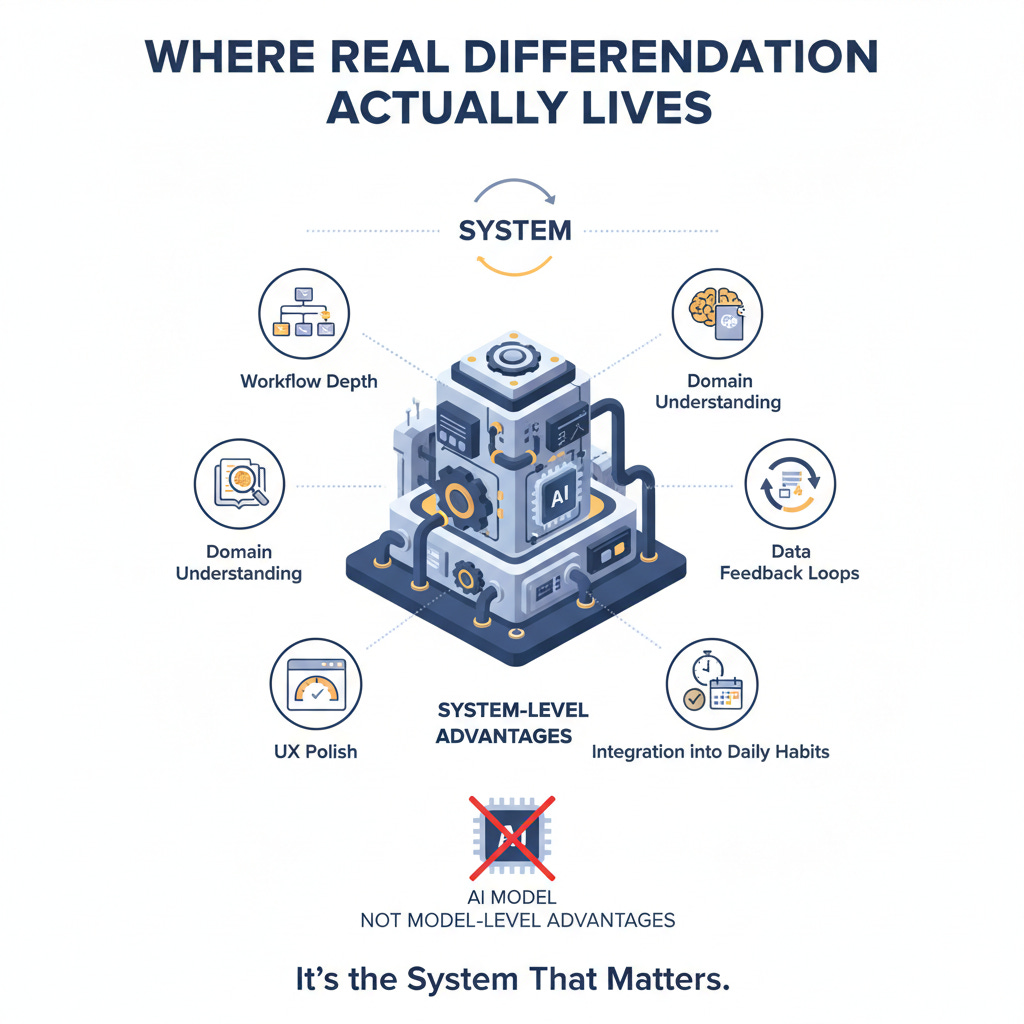
AI Is the Engine. Users Care About the Vehicle.
Users don’t care:
Which model you used
Whether it’s fine-tuned
If it’s open-source or proprietary
They care:
Does this save me time?
Does this reduce errors?
Does this fit how I actually work?
Can I trust it?
That’s why the best AI products feel boring in the best way.
They don’t announce themselves.
They just remove friction.

PM Reality: AI Parity Is Coming Faster Than You Think
If your differentiation is:
“We added GPT”
“Our AI is smarter”
“We have a better prompt”
You’re on borrowed time.
Parity is inevitable.
The real question PMs should be asking is:
“What still works when AI becomes invisible?”
Competing Above the Model Layer
Strong AI strategy today looks like:
Treating models as replaceable
Designing systems that survive model swaps
Investing in product intuition, not prompt cleverness
Building moats users feel, not features they screenshot
This is why the best teams quietly talk about:
Evaluation pipelines
Guardrails
Workflow fit
Human-in-the-loop design
Not demos.
When AI Can Still Be a Differentiator
There are exceptions, but they’re rare and structural:
Proprietary data
Highly regulated domains
Deep vertical specialization
Long feedback loops competitors can’t replicate
Even then, the model alone isn’t the advantage.
The system is.
The PM Takeaway (The Honest One)
If you’re building today:
Assume AI capability will equalize
Stop shipping features just because they “use AI”
Measure success by outcomes, not outputs
Invest in boring reliability
Design products that still make sense without buzzwords
Final Thought
The most powerful technologies stop being visible.
They don’t impress.
They don’t explain themselves.
They quietly disappear into everything.
AI is heading there fast.
And the teams who understand this shift early
will build products that last long after the hype moves on.
The "novelty half-life" framing is sharp—I've been exploring a similar angle over at Beyond the Seat regarding procurement cycles. CIOs now budget AI as operational expense, not innovation capital. The real tell: when vendors stop leading with "AI-powered" and start with workflow outcomes instead.