
Distribution Is the Only AI Moat Left

For three years we obsessed over intelligence.
Who’s smartest.
Who benchmarks higher.
Who reasons better.
That phase is ending.
The uncomfortable truth?
Models are converging.
And when intelligence converges, distribution decides everything.
There was a time when GPT-4 felt untouchable.
Then came Claude.
Then Gemini.
Then DeepSeek.
Each cycle felt existential for a week.
And then… nothing dramatic happened.
Because for most users, the delta isn’t life-changing.
Yes, one model is better at coding.
Another is better at reasoning.
Another is cheaper.
But none of them are 10x better.
And 10x is what creates lock-in.
2–5% improvements create tweets.
Not empires.
1. Google Doesn’t Need to Win the Model War
Let’s be honest.
Google doesn’t need the smartest model.
It needs the most embedded one.
Search.
Gmail.
Docs.
Sheets.
Android.
Chrome.
Billions of daily surfaces.
If Gemini is “good enough,” Google wins by default placement alone.
Distribution is a cheat code.
You don’t need users to switch.
They’re already there.
OpenAI has to convince you to open ChatGPT.
Google just slides Gemini into your workflow quietly.
One feels optional.
The other feels native.
That difference compounds.
2. Microsoft Is Playing a Boring, And Winning Game
Microsoft doesn’t care about Twitter benchmarks.
It cares about procurement.
Copilot is embedded inside Office.
Enterprises don’t rip out infrastructure because a new model scores 2% higher on MMLU.
They care about:
Compliance.
Integration.
Vendor relationships.
Multi-year contracts.
The assistant inside Excel beats the assistant with marginally better reasoning.
Because Excel is where the work already is.
That’s the moat.
3. Apple Is Playing a Longer Game
Apple is not trying to dominate API calls.
It’s doing something more dangerous.
On-device AI.
If Siri becomes meaningfully competent — even 70% as capable as frontier models — Apple controls the most intimate AI surface on earth:
Your phone.
Your notifications.
Your voice commands.
Your personal context.
No sign-ups.
No subscriptions.
No switching friction.
Just default.
And default wins.
It always has.
4. OpenAI’s Structural Problem
This is where it gets uncomfortable.
OpenAI built the breakthrough.
But it doesn’t own the rails.
No operating system.
No browser.
No email client.
No productivity suite.
No device layer.
It relies on user intent.
And user intent is volatile.
If models become interchangeable, the one with built-in distribution quietly eats the one with standalone brilliance.
That’s not an opinion.
That’s platform economics.
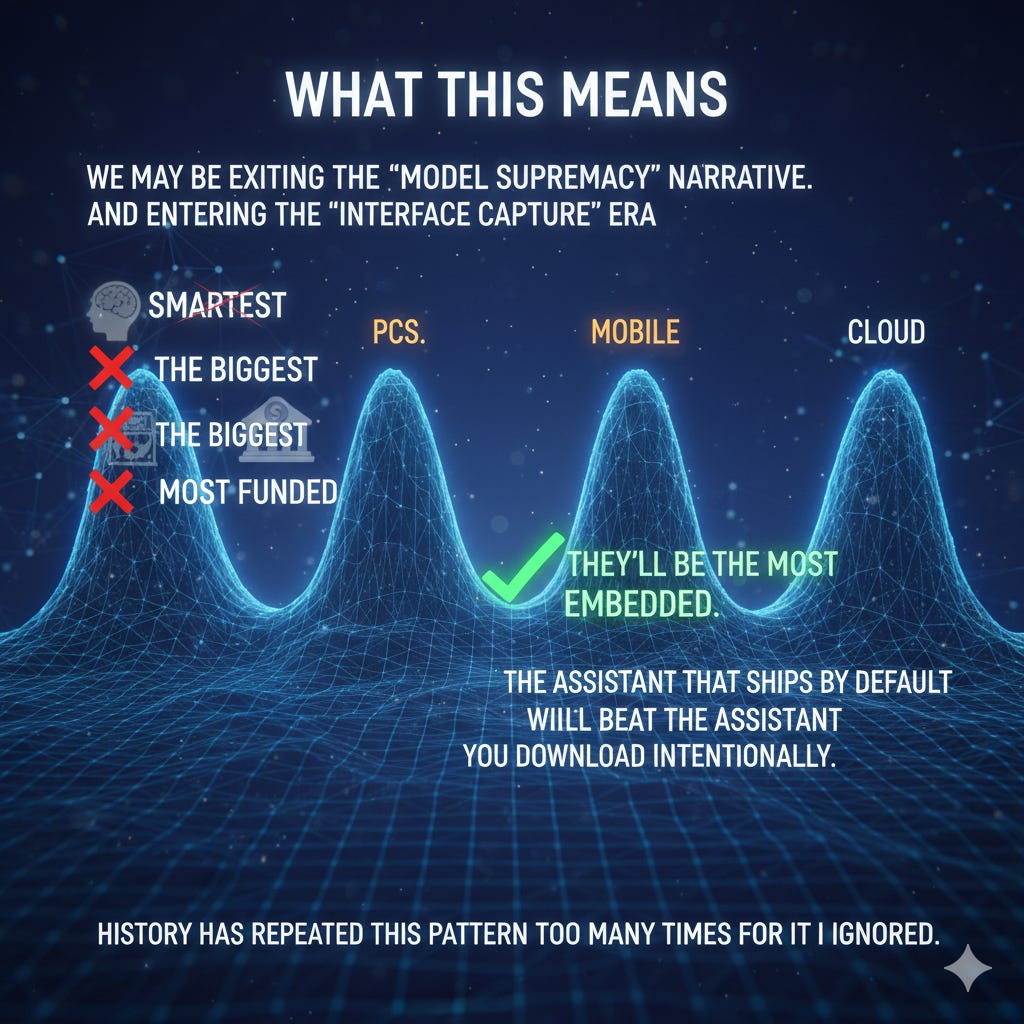
What This Means
We may be exiting the “model supremacy” narrative.
And entering the “interface capture” era.
The winners won’t necessarily be:
The smartest
The biggest
The most funded
They’ll be the most embedded.
The assistant that ships by default will beat the assistant you download intentionally.
History has repeated this pattern too many times for it to be ignored.
Closing Thought
Intelligence is becoming a commodity.
Attention is not.
Distribution is not.
Default placement is not.
The AI race isn’t ending.
It’s just moving layers.
And the layer that matters now… isn’t the model.
Until next week.