
Multi-Agent AI Systems: How They Work & Why They’re the Future of Intelligence
Multi-agent systems aren’t a feature upgrade. They are a new species of intelligence.

GPT-4 isn’t the destination - it’s a dead end.
The next breakthrough in AI won’t be one giant model…
It will be thousands of intelligent agents cooperating to solve problems no single model ever could.
Multi-agent systems aren’t a feature upgrade.
They are a new species of intelligence.
Multi-agent AI is no longer a research paper fantasy.
It is the direction AI is actually moving - quietly, inevitably, and faster than most people realize.
Today’s LLMs behave like powerful autocomplete engines:
smart, fluent, impressive - but fundamentally isolated.
Tomorrow’s AI systems will behave like societies of intelligent agents working together, reasoning together, negotiating together, and solving problems no single model ever could.
If you want to understand where AI is heading in the next 3 years, you must understand multi-agent systems.
Because the future of intelligence won’t be bigger models.
It will be many models, working as one.
Why Multi-Agent Matters
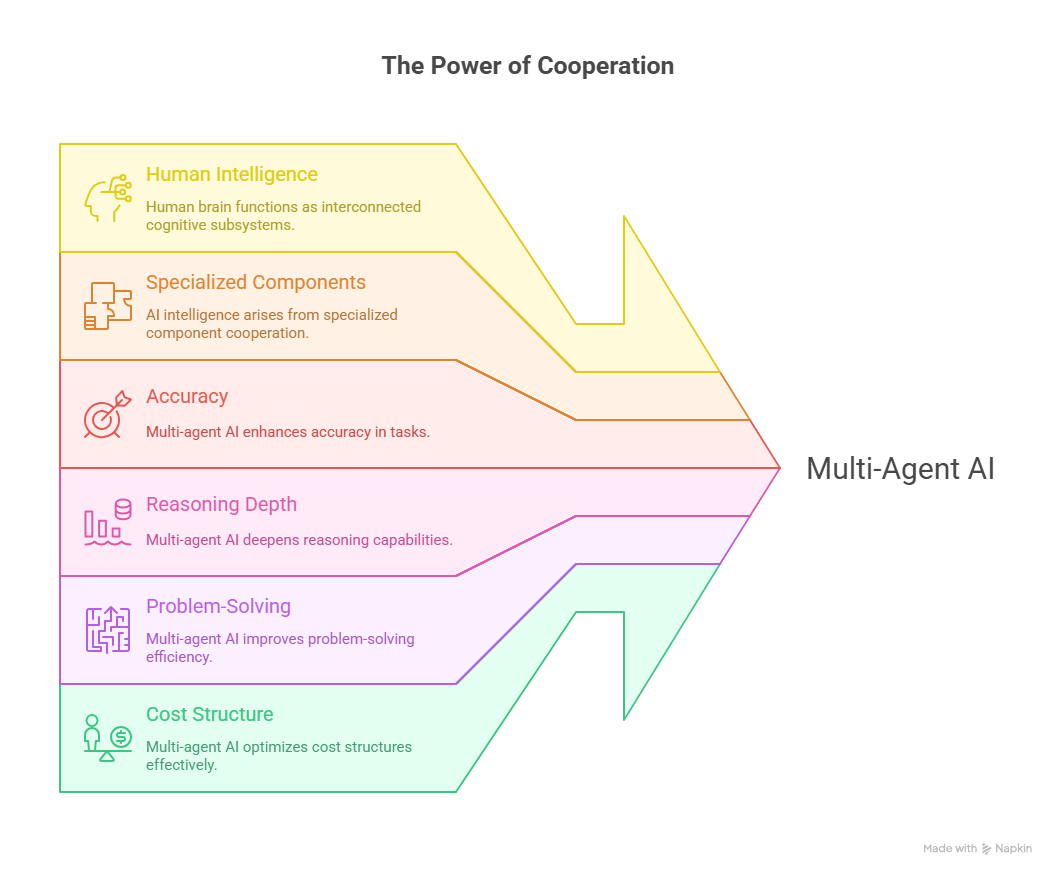
Look at human intelligence:
We aren’t one brain.
We are thousands of cognitive subsystems exchanging signals - memory, planning, language, motor control, perception.
AI will mirror the same pattern:
intelligence emerges not from a single giant model, but from cooperation between specialized components.
That shift changes everything:
accuracy
reasoning depth
problem-solving
cost structure
safety
and autonomy
Multi-agent AI is the next evolutionary leap.
What Is a Multi-Agent AI System?
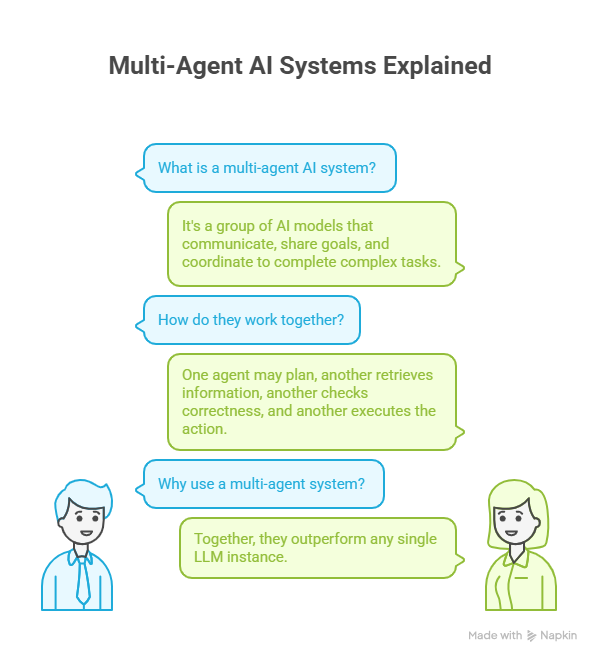
A multi-agent AI system is a group of AI models or agents that:
have unique skills or roles
communicate with each other
share goals
and coordinate to complete complex tasks
One agent may:
plan,
another retrieves information,
another checks correctness,
another executes the action.
Together - they outperform any single LLM instance.
Why Single LLMs Are Not Enough
Today’s LLMs show four major limitations:
LLM Limitation
Multi-Agent Fix
Hallucinations
Peer verification
Shallow reasoning
Specialist decomposition
Cost inefficiency
Role-based routing
Fragile prompts
Dynamic correction loops
Multi-agent solves structural limits - not cosmetic issues.
Why Multi-Agent AI Systems Work Better
Multi-agent systems combine:
1 Division of labor
Just like people, AI agents specialize.
Planner > Retriever > Solver > Validator.
2 Feedback loops
Agents critique each other - better outputs.
3 Emergent behaviour
Capabilities not programmed - appear naturally.
4 Redundancy & reliability
One agent fails? Another corrects it.
This is why companies like:
OpenAI, Anthropic, DeepMind, Microsoft, Google, Meta
are all building agent frameworks right now.
Why Multi-Agent Systems = The Next “Moore’s Law” of Reasoning
For 10 years, AI improved by scaling model size:
More parameters = more intelligence.
But we are reaching limits:
compute cost
inference cost
latency
training complexity
The next scaling curve is:
multi-agent cooperation - exponential reasoning ability.
How Multi-Agent Systems Actually Work (Core Loop)
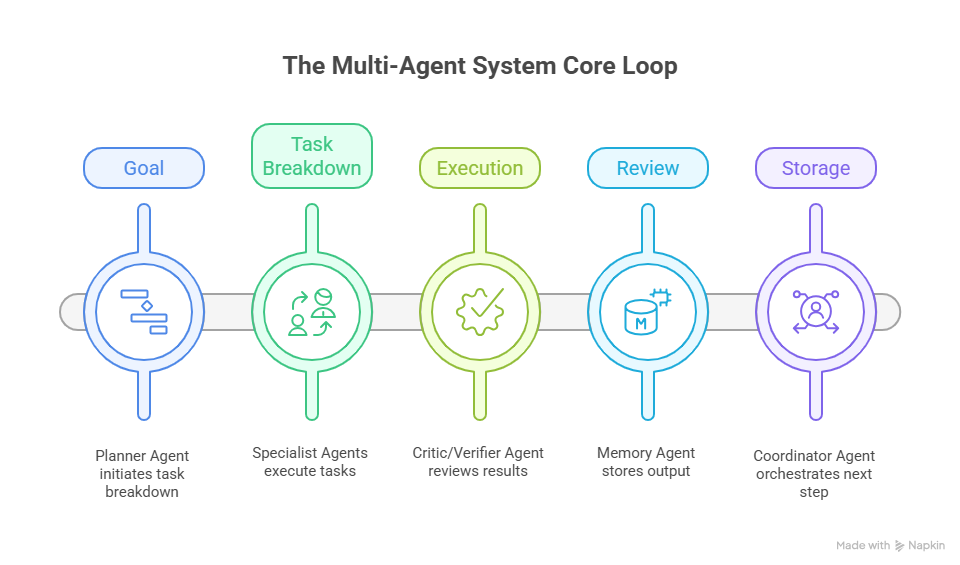
Goal → Planner Agent → Task Breakdown
↓
Specialist Agents Execute
↓
Critic/Verifier Agent Reviews
↓
Memory Agent Stores Output
↓
Coordinator Agent Orchestrates Next Step
This loop continues until completion.
Think of it like the human brain’s cortex - different regions solving different sub-problems.
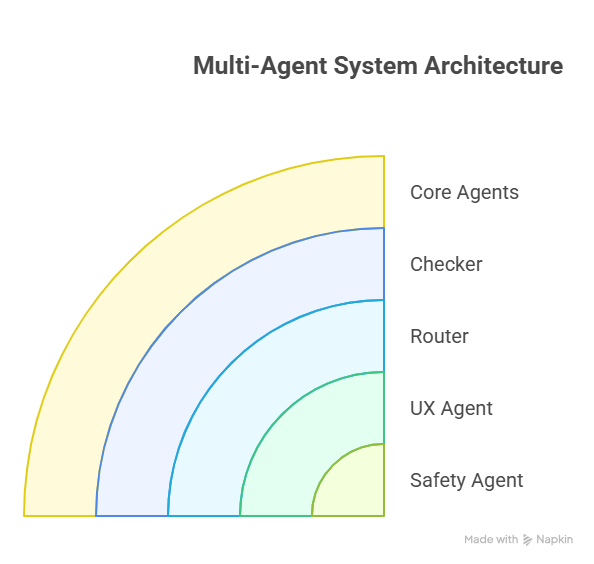
Example Architecture of a Multi-Agent System:
Agent Role
Function
Planner
Defines steps + strategy
Researcher
Finds information
Solver
Produces answers
Checker
Validates correctness
Memory
Stores knowledge
Router
Assigns tasks
Safety Agent
Screens outputs
UX Agent
Translates for humans
This looks like a workforce - not a prompt.
Real Use Cases Already Emerging
1 Deep research automation
Multi-agent research teams outperform humans in:
literature review
academic scanning
summarization
citation tracing
2 Autonomous coding
Two agents = code generation
Third = debugging
Fourth = security scan
GitHub Copilot is the seed.
Agentic IDEs are the future.
3 Robotics and embodied AI
Agents coordinate:
vision - planning - motion - error correction.
4 Complex business workflows
Finance, law, architecture, journalism - multi-agent is already arriving.
Why Multi-Agent Systems Produce Better Reasoning
LLMs hallucinate because they reason alone.
Add a critic agent - hallucinations drop.
Add a verifier agent - truth improves.
Add retrieval agent - grounded knowledge rises.
Solo models guess.
Teams of models think.
The Science: Emergent Intelligence
Studies show multi-agent groups begin to:
invent strategies,
negotiate,
debate,
collaborate,
and discover solutions nobody expected.
That is emergence
real sparks of intelligence.
This is why Google DeepMind has started:
multi-agent diplomacy models,
multi-agent protein folding,
multi-agent negotiation research.
It works.
A Real Example: Multi-Agent Coding
Single LLM:
Writes code - 40% error rate.
Multi-Agent team:
one writes code,
second tests code,
third fixes bugs,
fourth checks logic.
Error rate drops drastically.
Why the Future Won’t Be One Giant Model
Everyone imagines:
“GPT-8 will be a god model and solve everything.”
Reality:
Future AI = ecosystems.
Networks.
Swarms.
Just like the brain:
not one neuron - billions.
The Coming Agent Stack
Soon tools will look like:
Planner → Vision Agent → Math Agent → Code Agent → Reasoning Agent → Safety Agent
Not just “give model a prompt.”
We’re moving from word processors to automated research departments.
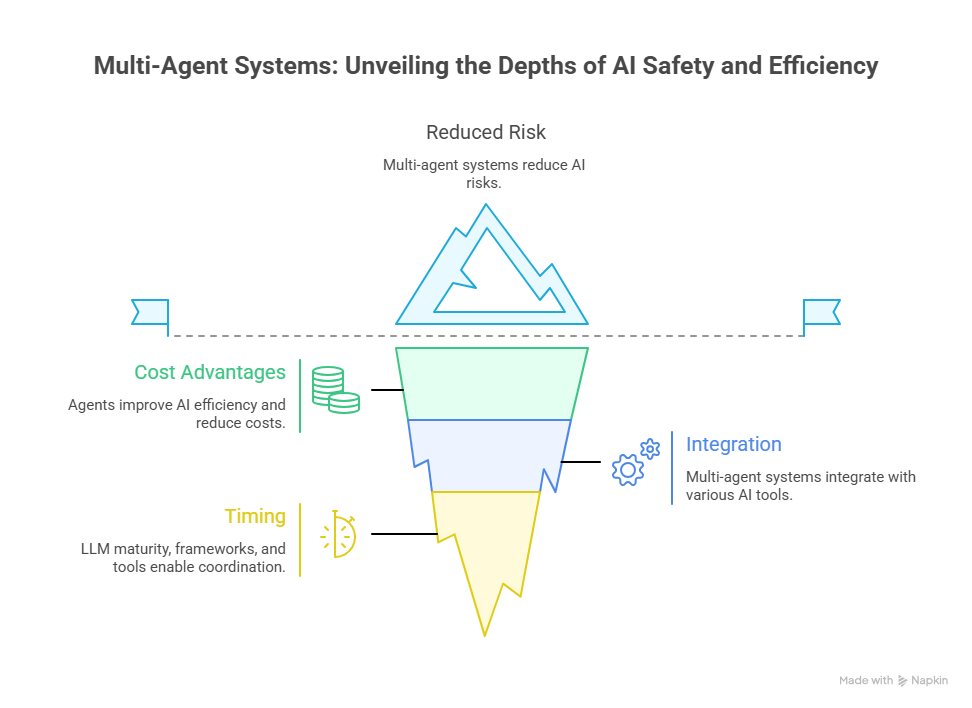
Why Multi-Agent Matters to AI Safety
Agent debate systems drastically reduce risk:
Two models debating a solution
outperform single models.
This prevents:
hallucination
bias
extremism
misinformation
Multi-agent = self-correcting AI.
Cost Advantages
Agents = efficiency.
Instead of:
GPT-4 everywhere,
You run:
cheap model for tasks
big model for reasoning
tiny model for recall
Routing solves cost bloat.
Integration With RAG, Memory & Tools
Multi-agent becomes unstoppable when combined with:
vector search
tool calling
structured memory
data caches
APIs
Each agent controls part of the pipeline - assembly line intelligence.
The Big Question: Why Now?
Three forces collided:
LLM maturity
agent frameworks
orchestration tools
This unlocked coordination at scale.
Future Outlook
By 2030, we will likely see:
autonomous research labs,
agent companies with no employees,
self-running businesses,
AGI flavours emerging from multi-agent swarms.
The winners won’t be those with the biggest models.
They’ll be those who design smarter agent societies.
Final Takeaway
Multi-agent AI systems are not a feature upgrade.
They are an intelligence paradigm shift.
LLMs today resemble talented individuals.
Multi-agent AI resembles organizations.
And history is clear:
organizations outperform individuals.
The future of AI isn’t a model.
It’s a system.
A team.
A society.
A network of intelligence woven together.
We are entering the age of agentic AI
and it will redefine what intelligence means.
The most dangerous question in the AI age sounds pragmatic:
“Where do we put the humans when AI does the work?”
It isn’t pragmatic. It’s diagnostic.
It reveals a hidden premise: humans are primarily functions—and “not being needed” becomes an existential defect.
AI doesn’t just change jobs. It relocates the bottleneck: from output to judgment—criteria formation, accountability, refusal, and the ability to stay coherent under uncertainty.
Essay here:
👉 https://open.substack.com/pub/leontsvasmansapiognosis/p/the-most-dangerous-question-in-the
— Leon Tsvasman
The most dangerous question in the AI age sounds pragmatic:
“Where do we put the humans when AI does the work?”
It isn’t pragmatic. It’s diagnostic.
It reveals a hidden premise: humans are primarily functions—and “not being needed” becomes an existential defect.
AI doesn’t just change jobs. It relocates the bottleneck: from output to judgment—criteria formation, accountability, refusal, and the ability to stay coherent under uncertainty.
Essay here:
👉 https://open.substack.com/pub/leontsvasmansapiognosis/p/the-most-dangerous-question-in-the
— Leon Tsvasman