
Vibe Coding Playbook for PMs
Ship MVPs With Cursor and Skip the Engineering Sprint

Let me tell you about two PMs I know.
The first one had a killer idea for a feature: a lightweight onboarding checklist that would cut activation drop-off. She wrote a PRD. Then a spec. Then she got on a grooming call, got bumped two sprints, and watched a competitor ship the same idea three weeks later. Her feature eventually launched. Four months after the original insight.
The second PM had a similar idea. He opened Cursor AI, typed a prompt, and had a working prototype by Thursday afternoon. He user-tested it on Friday. Real users. Real feedback. By the following week, he had enough signal to walk into the engineering meeting and say: “Here’s what users actually want. Here’s proof.”
Same idea. Completely different outcomes.
This is what vibe coding for PMs unlocks, and it’s changing what it means to be a product manager in 2025.
What Is Vibe Coding?
Vibe coding is the practice of building software by describing what you want in plain English, and letting AI do the heavy lifting of writing the actual code. You’re not becoming an engineer. You’re becoming a director. You set the vision, the AI executes a first draft, and you iterate toward something real.
The term was popularized by Andrej Karpathy, but the idea is already obvious to anyone who’s used tools like Cursor AI, Lovable, or Replit Agent. You describe a feature. You get working code. You tweak. You ship.
For product managers, this isn’t just a neat trick. It’s a fundamental shift in leverage.
You no longer have to choose between waiting for an engineering sprint or shipping something broken. There’s a third path: build a real prototype yourself, fast enough to matter.
Why This Changes Everything for Product Managers
Here’s what traditional PM workflows actually look like: idea → PRD → design review → grooming → sprint → QA → launch. That cycle, even in a fast team, rarely takes less than three weeks. More often it’s six.
The problem isn’t that engineers are slow. The problem is that the feedback loop is broken. By the time you’ve validated an idea, the market has moved, your stakeholders have new priorities, and you’ve lost the thread.
Vibe coding with AI tools for product managers compresses that loop to days.
Three things change immediately:
Speed. A prototype you can click through is worth ten pages of specs. You can test assumptions before a single line of production code is written.
Ownership. You stop being the person who describes the product and start being the person who shows it. That shift is enormous in how stakeholders, users, and engineers respond to you.
Feedback quality. When you put something in front of a user, even a rough, AI-generated prototype, you get real reactions. Not reactions to your description of a thing. Reactions to the thing itself.
Speed beats perfection in early stages. Always has. AI just made it possible for PMs to actually act on that truth.
The Minimal AI PM Stack
There are approximately nine thousand AI tools claiming to be essential for product development with AI. Ignore most of them.
Here’s the only stack you need to start:
Cursor AI: your primary build environment for vibe coding
ChatGPT or Claude: for thinking through strategy, drafting copy, and refining prompts
v0 by Vercel or Lovable: for rapid UI mockups when you need something visual fast
Linear or Notion: your existing PM workflow tool (don’t change this)
That’s it. One tool per category. The goal isn’t to have a fancy stack; it’s to ship something this week.
The fastest path to learning AI product management isn’t reading about it. It’s building something small, badly, and then building it again better.
The Vibe Coding Workflow (Step by Step)
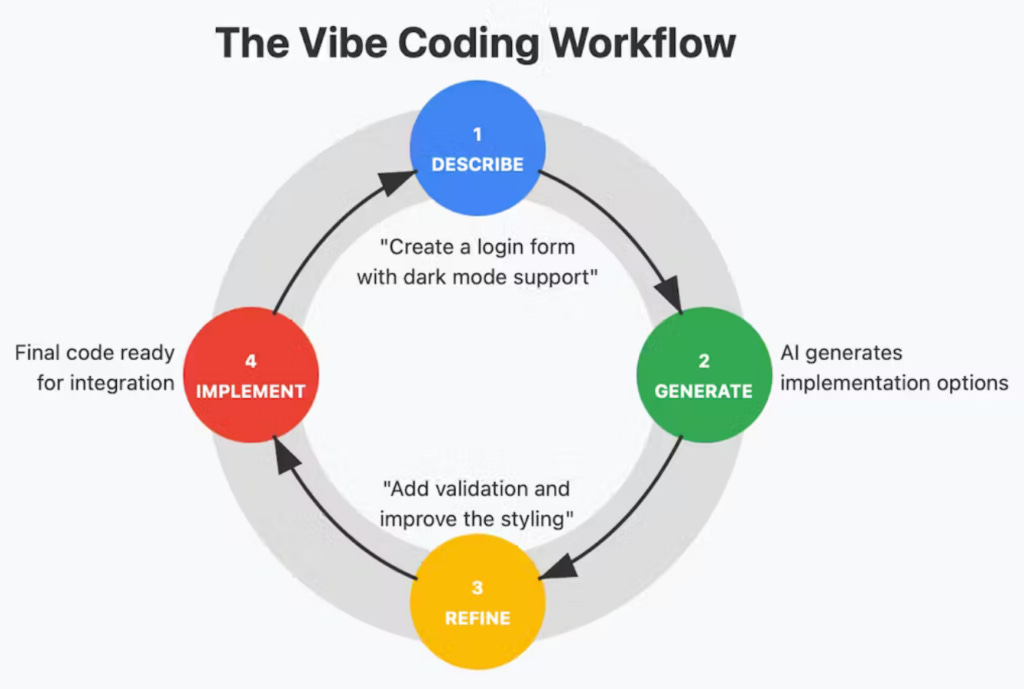
Here’s how the build MVP without engineers loop actually works in practice:
Step 1: Idea. Keep it small. Not “redesign onboarding.” Instead: “A single screen that shows new users the three things they should do first.” Specificity is everything.
Step 2: Prompt. Open Cursor. Don’t ask it to “build an app.” Describe the behavior. “Create a Next.js page with a three-step checklist. Each step has a title, a one-line description, and a checkbox. When all three are checked, show a ‘You’re ready!’ message.” Be literal. Be boring. Boring prompts produce working code.
Step 3: Prototype. Run what Cursor gives you. It won’t be perfect. It might be wrong in places. That’s fine. You’re not shipping this to production. You’re creating something to react to.
Step 4: Iterate. This is the actual skill. Look at what you have, decide what’s wrong, and write another prompt. “The checkboxes don’t persist on refresh, add localStorage.” “Change the header font to something lighter.” “Make the call-to-action button more prominent.” Each iteration costs you three minutes, not three days.
Prototype is the new PRD. The faster you internalize this, the faster your career trajectory changes.
The Cursor Playbook: How a PM Actually Builds
Let’s get tactical. Here’s how to use Cursor AI as a product manager with zero engineering background.
Your first prompt matters most. Don’t start with “build me a dashboard.” Start with one screen, one interaction, one outcome. Cursor is exceptionally good at generating clean, working code when the scope is tight. When the scope is vague, you get vague results.
A PM-friendly starter prompt looks like this:
“Build a simple HTML/CSS/JS page. It should show a product waitlist form with an email input and a submit button. On submit, display a thank-you message and store the email in localStorage. Keep the design minimal and clean.”
That’s it. Run it. Open the browser preview. You now have something real.
Iteration is where the magic is. Once you have a working base, treat Cursor like a pair programmer. Describe what you see, describe what you want instead, and ask for the change. “The button color doesn’t stand out, make it a bold indigo.” “Add a character counter under the input field.” “Center everything vertically on the page.”
When something breaks, don’t panic. Paste the error message directly into Cursor’s chat and ask: “What does this error mean and how do I fix it?” It will explain and fix. This alone removes 80% of the intimidation factor around AI coding tools.
Shipping your MVP doesn’t require DevOps wizardry. Drop the folder into Vercel, Netlify, or Replit’s hosting; free tiers are more than enough. Now you have a live URL you can send to real users. That URL is worth more than the most polished PRD you’ve ever written.
From AI Slop to Real Product
Here’s the honest part: the first thing Cursor builds you will be mediocre.
Colors will be off. Copy will be a placeholder. The interaction will feel rough. This is not a failure. It’s a first draft, and first drafts are supposed to be rough.
The discipline of rapid prototyping with AI is learning to see the gap between what the AI generated and what the product needs to be. Then closing that gap, one prompt at a time.
Don’t accept the first output. Edit it. Redirect it. Ask for a different approach. The PMs who get the most out of vibe coding aren’t the ones who trust the AI blindly; they’re the ones who stay opinionated throughout the process.
Think of it like working with a very fast, very literal junior developer. Technical execution is fast. Taste and judgment still come from you.
The Mindset Shift: From Spec Writer to Builder
This is the uncomfortable part.
Most PM culture is built around documentation, alignment, and coordination. You write the spec. Someone else builds. You review. You ship. The PM role has historically been about influence without authority.
Vibe coding breaks that model. Or rather, it extends it.
You can still write specs. You can still align stakeholders. But now you can also show up with a working prototype that was built in an afternoon. And that changes every conversation you’ll ever have about a feature.
The shift looks like this:
Specs → Prototypes
Planning cycles → Shipping cycles
“Here’s what I’d like to build” → “Here’s what I built, here’s what users said”
This is the future of product management, not PMs replacing engineers, but PMs who can move the first mile themselves, armed with enough signal to make engineering time count.
Risks and the Reality Check
Don’t let the excitement cloud your judgment. There are real limits here.
AI-generated code has bugs. Sometimes subtle ones. Never push vibe-coded prototypes directly to production without an engineer reviewing it. Security vulnerabilities, unoptimized queries, poor error handling. These are real risks in code you didn’t write and don’t fully understand.
Scope creep is deadly. The ease of building can seduce you into building more than you should. Stay disciplined. One feature at a time. Validate before you expand.
AI doesn’t replace engineers; it compresses the loop. Your goal isn’t to eliminate the engineering sprint. It’s to earn it. You show up with validated signal, tested prototypes, and clear requirements. Engineers work on things that are already de-risked. That’s a better use of everyone’s time.
Use this power for exploration and validation. Not for shipping production features solo. The distinction matters.
The Future Belongs to the PMs Who Build
AI-native product teams are already emerging at startups where a single PM with Cursor can test five ideas in the time it used to take to spec one.
PM workflow automation isn’t about automating your job away. It’s about automating the friction: the waiting, the miscommunication, the lost context between idea and implementation.
The product managers who thrive in the next five years won’t just be the best writers of specs or the best facilitators of sprints. They’ll be the ones who can think and build simultaneously, who treat every idea as a prototype waiting to happen, not a document waiting to be approved.
Build Something This Week
Not the next sprint. Not next quarter. This week.
Pick the smallest, most annoying user problem on your current roadmap. The one that keeps getting pushed because it “doesn’t hit the threshold.” Open Cursor. Write one prompt. Build one screen.
You don’t need it to be perfect. You need it to be real.
Because here’s the thing nobody tells you about vibe coding for PMs: the first prototype you ship won’t change your product. It’ll change you. The moment you realize you can build something tangible in an afternoon, you will never see a waiting sprint the same way again.
The best PMs in 2025 aren’t waiting for permission to build. They’re shipping, learning, and coming to the table with proof.
The only question is whether you’ll be one of them.
If this was useful, share it with a PM who’s still waiting on their next sprint to prove an idea that could be tested today.
And if you build something using this playbook, reply and tell me what you made. I read every response.
Keywords: vibe coding, vibe coding for PMs, AI product management, Cursor AI, build MVP without engineers, AI tools for product managers, rapid prototyping with AI, no-code MVP, AI coding tools, PM workflow automation, product development with AI, prototype vs PRD, AI prototyping tools, future of product management