
Your AI Roadmap Is Probably Wrong
What Recent Model Releases Actually Signal


If your 2026 AI roadmap still revolves around faster responses, better chat interfaces, and “AI-powered” features, you’re optimizing for a problem that no longer matters.
The past wave of model releases, GPT-5 class reasoning models, Claude’s extended thinking modes, DeepSeek-R1 and other open reasoning systems, didn’t just improve benchmarks.
They changed what AI systems are for.
And most enterprise roadmaps haven’t caught up.
The Real Shift: From Fluency to Deliberation
From 2023 to 2025, AI progress was largely about fluency.
Better conversation.
Better summarization.
Better code autocomplete.
Faster responses.
Models behaved like very smart interns, quick, intuitive, probabilistic.
What changed in late 2025 and early 2026 is this:
Models began trading speed for structured reasoning.
Instead of generating one fast answer, they:
Run internal reasoning passes
Self-critique
Break problems into steps
Call tools iteratively
Re-evaluate intermediate outputs
That sounds subtle.
It’s not.
It means AI systems are no longer just answering questions.
They’re executing decisions.
And that breaks most roadmaps.
Roadmap Mistake #1: Optimizing Everything for Latency
For two years, product teams obsessed over sub-second responses.
Fast chat.
Instant suggestions.
Real-time generation.
But reasoning-first systems don’t behave like that.
They pause.
They evaluate.
They simulate options.
They verify logic.
If you force these systems into real-time UX constraints, you’re neutering their advantage.
Here’s the uncomfortable question:
Would your CFO prefer:
A supply chain decision in 0.4 seconds
orA correct one in 4 seconds?
The mistake isn’t speed.
The mistake is treating all AI interactions as chat interactions.
In 2026, you need two loops:
Fast loops → low-stakes assistance
Slow loops → high-stakes decisions
If your roadmap doesn’t distinguish between the two, it’s structurally flawed.
Roadmap Mistake #2: Building “AI Features” Instead of AI Responsibilities
Most 2025 AI roadmaps looked like this:
AI summarization
AI chatbot
AI insights tab
AI co-pilot
Feature layering.
But reasoning-capable systems shift the unit of product thinking from “feature” to “responsibility.”
The real question is no longer:
What can the AI say?
It’s:
What can the AI own?
For example:
Can it reconcile month-end accounts autonomously?
Can it triage inbound legal documents?
Can it optimize inventory allocation within defined guardrails?
That requires defining:
The outcome
The constraints
The tools it can access
The cost limits
Not prompts.
Not chat flows.
Ownership boundaries.
If your roadmap is still structured around UI enhancements instead of delegated decision zones, you’re planning for the wrong generation of systems.
Roadmap Mistake #3: Treating the Model as the Product
Another dangerous illusion:
“We just need the most powerful model.”
Recent releases prove something uncomfortable:
Context and connectivity now matter more than raw model size.
The biggest bottleneck in enterprise AI today isn’t intelligence.
It’s access.
Access to internal databases
Access to structured workflows
Access to APIs
Access to permissions
Access to transaction layers
A reasoning model without system connectivity is a brilliant outsider.
A moderately capable model with deep integration is a force multiplier.
This is where most roadmaps collapse.
Teams prioritize:
Model upgrades
Benchmark improvements
Prompt refinements
Instead of:
API exposure
Machine-readable interfaces
Clean data pipelines
Durable execution environments
The winning question in 2026 isn’t:
How smart is the model?
It’s:
How deeply can it act inside your system?
Roadmap Mistake #4: Ignoring Nondeterminism
Traditional software is deterministic.
Input A → Output B.
Reasoning systems aren’t.
They produce trajectories.
They:
Take different paths
Call tools in varying sequences
Make probabilistic intermediate decisions
If your testing strategy still expects fixed outputs, it will fail.
You don’t evaluate reasoning systems by:
“Did it return the exact same string?”
You evaluate them by:
Did it follow safe reasoning steps?
Did it respect constraints?
Did it stay within cost boundaries?
Did it reach acceptable decision quality?
This requires a new evaluation layer.
And most roadmaps don’t account for it.
What the Model Releases Actually Signal
Let’s zoom out.
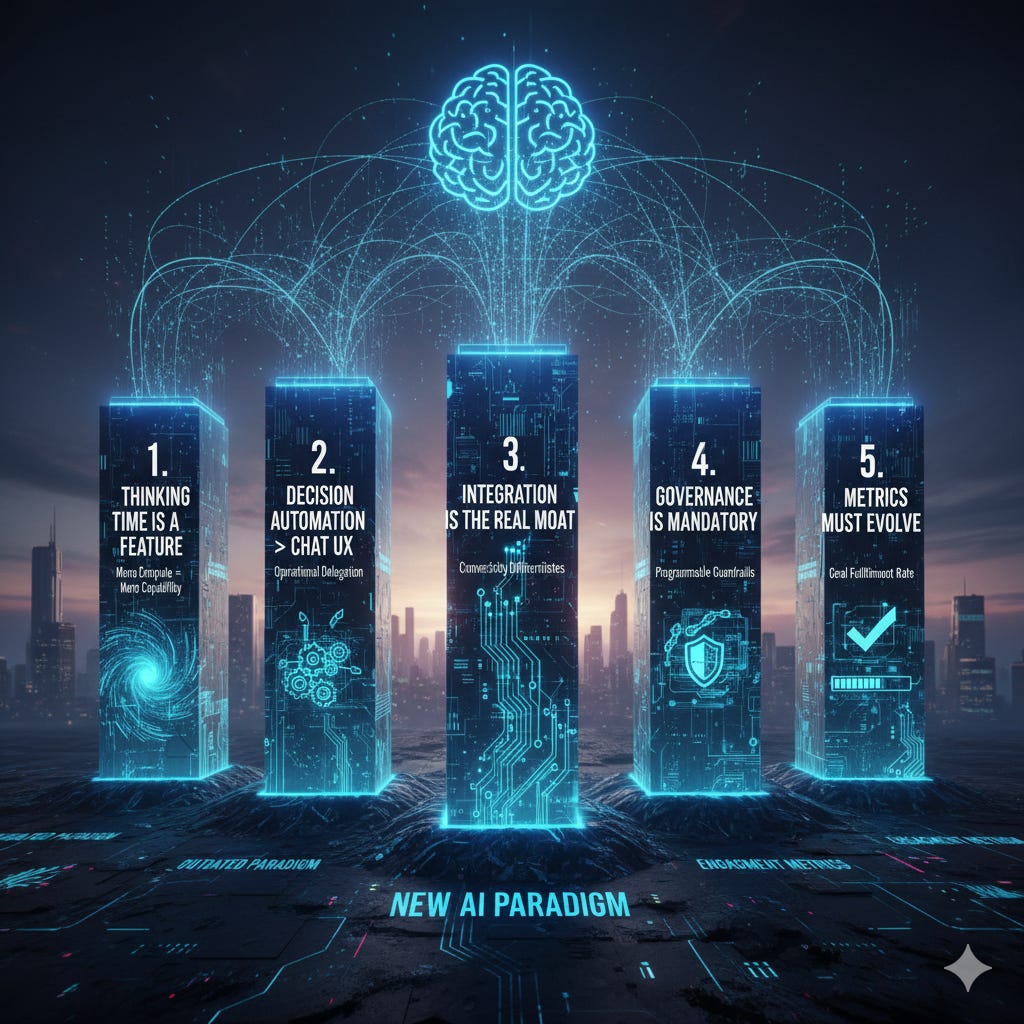
The past year’s releases collectively signal five structural shifts:
1. Thinking Time Is Now a Feature
More compute at inference is not inefficiency — it’s capability.
2. Decision Automation > Chat UX
The frontier isn’t conversational polish.
It’s operational delegation.
3. Integration Is the Real Moat
Intelligence is commoditizing.
Connectivity is differentiating.
4. Governance Is Mandatory
Autonomous systems need programmable guardrails.
5. Metrics Must Evolve
Daily active users mean little if the AI doesn’t meaningfully complete goals.
The new metric isn’t engagement.
It’s goal fulfillment rate.
The Strategic Reframe
If you’re leading AI product strategy in 2026, your roadmap should revolve around three questions:
What decisions can we safely delegate?
What infrastructure allows safe execution?
How do we measure decision quality at scale?
Not:
How many AI features can we ship?
How many users tried the chatbot?
How fast does it respond?
Those were 2025 questions.
The Uncomfortable Conclusion
The winners of late 2026 won’t be the companies with the flashiest models.
They’ll be the ones that built:
Clean system access layers
Explicit AI ownership boundaries
Durable execution frameworks
Evaluation systems for reasoning quality
Cost-aware compute governance
In other words:
An immune system for autonomy.
Your roadmap shouldn’t be a list of what the AI will say.
It should be a definition of what the AI will own,
and the constraints under which it operates.
If you’re still planning around chat windows and latency optimization, you’re not building for reasoning systems.
You’re optimizing for a version of AI that already peaked.
The latency vs. correctness framing is spot-on—most AI product teams are still optimizing for conversational speed when the real value is in deliberative accuracy. I've been exploring a similar angle over at Beyond the Seat around how procurement cycles will need to fundamentally shift when evaluating reasoning-first systems versus chat-wrapper products.